
Groundwater Monitoring: Why Regular Control Is Important for Cities and Industrial Areas
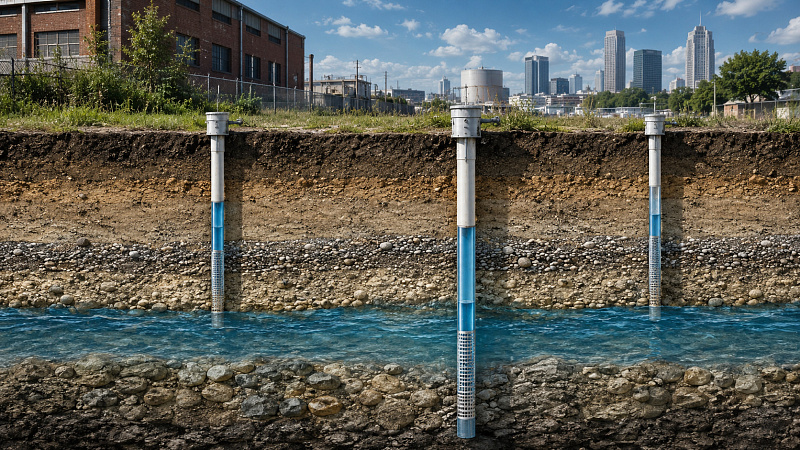
Groundwater is an important part of both the natural environment and urban infrastructure. It affects soils, buildings, engineering networks, agriculture and water supply. At the same time, changes in groundwater often remain invisible until the problem becomes serious.
Regular monitoring makes it possible to observe water level, temperature, conductivity, salinity and other parameters over time. Such data are especially important for cities, industrial sites, irrigated territories, mining areas and zones where flooding or contamination risks may occur.
A groundwater monitoring system helps track:
- rise or decline of water level in observation wells;
- changes in salinity and electrical conductivity;
- temperature fluctuations;
- seasonal influence of precipitation and irrigation;
- possible impact of industrial sites, landfills, agriculture or construction works;
- long-term trends that cannot be seen through single measurements.
For these tasks, specialists use level sensors, data loggers, downhole instruments, telemetry modules and software for storing and analyzing results. Depending on the project, the system may work autonomously or transmit data remotely to specialists.
The most important benefit of groundwater monitoring is that decisions can be based on facts. If the water level rises, specialists can assess the risk of flooding in advance. If conductivity changes, there may be a reason to check for possible inflow of salts or pollutants.
Proper monitoring starts with the selection of control points. Observation wells should reflect the real situation on the site: upstream and downstream of groundwater flow, near potential sources of impact and in background areas.
Groundwater should not be monitored only when a problem has already appeared. Reliable assessment requires a history of observations. The more data are accumulated, the easier it becomes to understand whether a change is a random fluctuation, a seasonal norm or a sign of environmental risk.